
GLAUCOMA LASER, MIGS & SURGICAL TREATMENT IN BRISBANE
Glaucoma Specialist Brisbane
Comprehensive, personalised glaucoma care - from early detection to laser and surgical treatment, tailored to protect your vision for the long term.
Comprehensive, personalised glaucoma care
Glaucoma can usually be managed effectively when detected and treated early. Dr Geoffrey Ryan provides comprehensive glaucoma care, from careful monitoring and Selective Laser Trabeculoplasty (SLT) through to minimally invasive and complex glaucoma surgery, with treatment tailored to your eyes and individual needs.


What is glaucoma?
Glaucoma is a group of eye conditions that cause progressive damage to the optic nerve, which connects the eye to the brain. It often develops slowly and without noticeable symptoms.
If left untreated, glaucoma can gradually affect peripheral vision and eventually more central vision. Early detection and appropriate treatment can significantly reduce the risk of further vision loss.
Dr Ryan is a Glaucoma specialist with advanced training
During his training, Dr Ryan took a particular interest in glaucoma and took on advanced training in the medical, laser, and surgical management of this disease. He’s become a glaucoma specialist, through international training and advanced studies in this area.
No matter the severity of the disease, Dr Ryan provides a full spectrum of glaucoma treatment and management, from routine monitoring and tests for glaucoma, to complex surgical intervention.

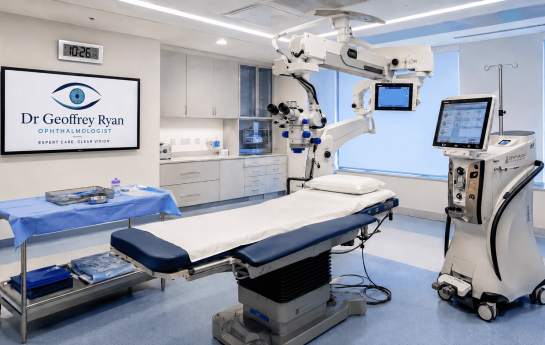
We use world-leading equipment
Consulting and operating out of the Queensland Eye Institute, we’re fortunate to have the best of the best in terms of medical tools and equipment. We have state of the art facilities, supporting both us and you, the patients in your diagnosis and treatment journey.
Glaucoma Treatments Offered by Dr Ryan
Laser Treatments
In-office, incision-free treatments that use targeted light to improve drainage or reduce fluid production. Usually the first step, and often repeatable.
SLT — Selective Laser Trabeculoplasty +
A glaucoma treatment that consists of light energy being applied to the eye's natural drainage pathway. This laser treatment is performed in the clinic, is pain-free, and only takes a few minutes. It's an excellent option as a first-line glaucoma treatment, and Dr Ryan, as a glaucoma specialist, is experienced in delivering it.
LPI — Laser Peripheral Iridotomy +
A laser treatment that creates a small opening in the peripheral iris to relieve a narrow or blocked drainage angle. It's a quick, in-clinic procedure used to treat and prevent angle-closure glaucoma, particularly in eyes identified as having narrow angles on examination.
Cyclodiode Laser Treatment +
Rather than improving drainage, cyclodiode laser targets the ciliary body to reduce the amount of fluid the eye produces, lowering pressure at the source. It's typically used for more advanced or harder-to-control glaucoma, including cases where other treatments haven't achieved the target pressure.
Minimally Invasive Glaucoma Surgery (MIGS)
Minimally Invasive Glaucoma Surgery is the new generation of glaucoma treatment, using microscopic implants placed through a tiny incision — often at the same time as cataract surgery. It's now standard of care for glaucoma patients having cataract surgery, and a welcomed alternative to more invasive treatments.
Hydrus — Hydrus Microstent +
A flexible microstent inserted into the eye's natural drainage canal (Schlemm's canal), holding it open along a wide arc to improve outflow over a larger area than a single-point device. Hydrus is commonly implanted at the same time as cataract surgery.
iStent — Trabecular Micro-Bypass Stent +
One of the smallest medical devices implanted anywhere in the body. iStent creates a direct bypass through the trabecular meshwork, giving fluid a more direct route out of the eye and reducing reliance on drops.
MINIject — Supraciliary Micro-Stent +
Placed in the supraciliary space, MINIject drains fluid via the eye's uveoscleral pathway — a different route from most MIGS devices. It's a useful option when the trabecular (canal-based) route alone isn't expected to be enough.
iTrack — Microcatheter-Assisted Canaloplasty +
A fine microcatheter is threaded all the way around Schlemm's canal to open up the eye's natural drainage system 360 degrees. It can be performed alone or combined with another MIGS device, such as Hydrus, for eyes that need more than one mechanism of outflow improved.
Advanced Glaucoma Treatments
For glaucoma that hasn't responded adequately to drops, laser, or MIGS, Dr Ryan offers the full range of filtration and drainage-device surgery — creating a new, engineered pathway for fluid to leave the eye. Dr Ryan undertook advanced fellowship training in these complex procedures at Moorfields Eye Hospital in London, a global leader in glaucoma surgery.
Trabeculectomy +
The long-standing gold-standard glaucoma surgery. A new drainage channel is created under the conjunctiva, allowing fluid to filter out of the eye into a controlled, low-pressure reservoir beneath the eye's surface.
PreserFlo — MicroShunt +
A small, permanent tube implanted under the conjunctiva that offers a more standardised, less invasive alternative to traditional trabeculectomy, with a shorter and more predictable surgical technique.
Paul Tube — Glaucoma Drainage Device +
A slim-profile tube-shunt implant that channels fluid from inside the eye to an external reservoir plate. It's a valuable option in complex eyes, including those that have had previous glaucoma or other eye surgery.
Baerveldt Tube — Glaucoma Drainage Device +
A larger-plate drainage implant well suited to complex or refractory glaucoma — cases that haven't responded sufficiently to earlier treatment, including previous surgery.
Eyeplate S — Glaucoma Drainage Device +
The eyePlate-S from Rheon Medical is an innovative micro-invasive glaucoma drainage device, featuring a small-diameter tube and a flexible silicone end-plate — available in 200 mm² and 300 mm² sizes — designed to control fluid flow and reduce intraocular pressure safely.
Why trust Dr Geoffrey Ryan
You'll see Dr Ryan personally, every step of the way
Many glaucoma clinics rotate patients between different doctors. From your first consultation through to treatment and long-term follow-up, you'll be seen by Dr Ryan himself, so your care stays consistent, and so does the person delivering it.
We take on the complex procedures
Dr Ryan has spent years taking on additional training and research and is highly regarded for more complex glaucoma procedures. These extend to include trabeculectomy and tube surgery.
A wide array of treatments available
As a glaucoma specialist, Dr Ryan offers a wide array of treatments, including laser and minimally invasive glaucoma procedures. These treatments can reduce the need for long-term eye drops.
We’re actively advancing Glaucoma research
Research is essential to progress what we know about glaucoma and its treatments. Dr Ryan is actively involved in glaucoma research. He wants to ensure hi patients are always offered the latest in glaucoma treatment options.
You’ll understand your procedure
Dr Ryan will always take the time to explain your procedure to you, in full, ahead of your operation. You’ll have the opportunity to ask questions and walk away confidently.
When was your last eye test? Early detection is crucial

Book an appointment with a glaucoma treatment specialist today
Don’t let glaucoma steal your sight. Book an appointment with our glaucoma surgery specialists, and take action to prevent optic nerve damage and further damage to your vision.
Our experienced team uses cutting-edge techniques to effectively manage and treat glaucoma, helping to prevent vision loss, preserve your vision and improve your quality of life.
Don’t wait until it’s too late. Whether you have a confirmed case of glaucoma, or are experiencing some of the symptoms of glaucoma, such as pressure behind your eyes, blurred vision or other signs of poor eye health.
Book your appointment now and take the first step towards protecting your vision for years to come.
Our Glaucoma FAQs
Glaucoma Blog Posts

A higher standard of care for eye conditions.
Book your appointment below or call our eye centre to schedule your consultation. Our friendly team is happy to answer any questions you may have.
Or call us on (07) 3239 5000
Written and reviewed by Dr Geoffrey Ryan MBBS MMed BSc FRANZCO – Cataract, Corneal, Glaucoma and Refractive Surgeon
Last reviewed: 03 September 2026